Render vs Railway Pricing and Railway vs Render Monthly Cost for Production Apps
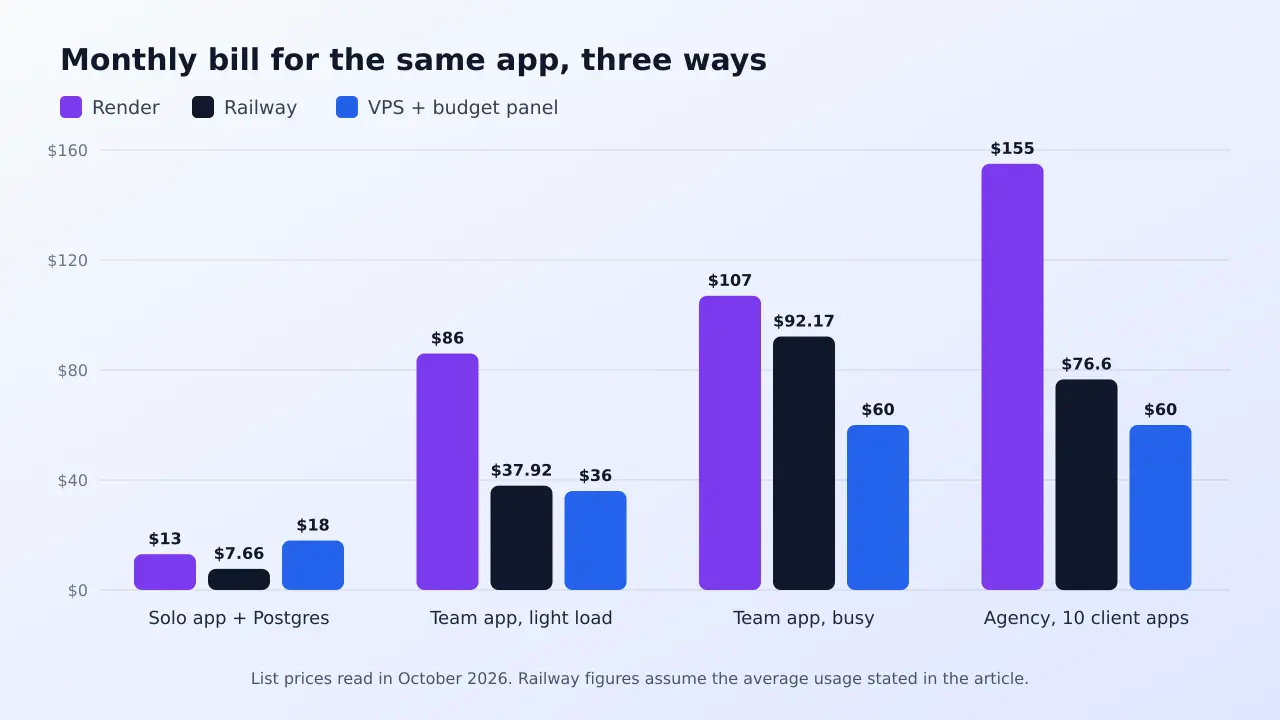
Render bills a fixed monthly price per service: $7 for 0.5 CPU and 512 MB, $25 for 1 CPU and 2 GB, plus $25 a month for a Pro workspace. Railway bills actual use at about $20.29 per vCPU and $10.14 per GB of memory a month, and its $20 Pro fee counts toward usage. A team app with a web service, worker, 1 GB Postgres and Redis costs $86 on Render and about $38 on Railway at light load, $107 against $92 when busy. Render only wins when services run near full load all month. A 4 GB server of your own with a $12 panel runs the same app for $36.
Skip the manual setup. DeployManage provisions your server and ships zero-downtime deploys on any cloud.
Get startedRender and Railway sell the same thing, a place to run a web app, a worker and a database without managing a server, and they bill it in opposite ways. (Running Laravel? We price both against Laravel Cloud in Laravel Cloud vs Render vs Railway pricing.) Render charges a fixed monthly price for each service you create. Railway meters the CPU and memory your services actually use, second by second. Which one costs less depends on how busy the app is and how many services it has, so this page works the bill out for four real setups instead of comparing sticker prices.
Every figure below was read from render.com/pricing and railway.com/pricing in October 2026 and is in USD per month.
Is Railway cheaper than Render?
For most small and medium apps, yes. Railway bills only the CPU and memory a service really consumes, at about $20 per vCPU and $10 per GB of memory a month, while Render bills the full instance size around the clock. A web service that averages a quarter of a vCPU and 1 GB of memory costs about $15 on Railway against $25 for Render's 1 CPU, 2 GB instance. Render gets closer, and can win, when services run near full load all month.
The second thing that moves the bill is the plan fee. Render's Pro workspace is $25 a month on top of compute. Railway's Pro plan is $20 a month and that $20 counts toward usage, so a team whose usage is $38 pays $38, not $58.
Render vs Railway pricing, plan by plan
| What you pay for | Render | Railway |
|---|---|---|
| Entry plan | Hobby workspace, $0 plus compute, 1 seat | Hobby, $5 a month including $5 of usage |
| Team plan | Pro workspace, $25 a month plus compute, unlimited seats | Pro, $20 a month including $20 of usage, unlimited seats |
| Larger plan | Scale, $499 a month plus compute | Enterprise, custom |
| How compute is billed | Fixed price per service, by instance size | Per second of vCPU and memory actually used |
| Small web service | $7 (0.5 CPU, 512 MB) | About $20.29 per vCPU and $10.14 per GB of memory used |
| Medium web service | $25 (1 CPU, 2 GB) | Same meter, up to 48 vCPU and 48 GB per service on Hobby |
| Large web service | $85 (2 CPU, 4 GB), $175 (4 CPU, 8 GB) | Same meter, up to 1,000 vCPU and 1 TB per service on Pro |
| Postgres | $6 (256 MB), $19 (1 GB), $40 (1 CPU, 2 GB), $55 (1 CPU, 4 GB), storage $0.30 per GB | Runs as a metered service, volume $0.15 per GB |
| Redis compatible store | Key Value $10 (256 MB), $20 (1 GB), $60 (3 GB) | Runs as a metered service |
| Persistent disk | $0.25 per GB | $0.15 per GB |
| Outbound bandwidth | 5 GB on Hobby, 25 GB on Pro, 1 TB on Scale, then $0.15 per GB | $0.05 per GB from the first gigabyte |
| Build minutes | 500 a month on Hobby, then $5 per 1,000 | Not listed as a separate charge on the pricing page |
Railway's two rates come from its published per second prices: $0.00000772 per vCPU second and $0.00000386 per GB second. Over a 730 hour month that is $20.29 for a vCPU that never rests and $10.14 for a gigabyte of memory that is always in use. Almost no web app runs like that. Memory use is fairly flat, but CPU on a typical web service sits well under a quarter of a core between requests, and that gap is where Railway's bill drops below Render's.
What the same app costs on each
Four setups, priced on both. The Render column uses the smallest instance that fits. The Railway column needs an assumption about average use, and it is written in the row so you can swap in your own numbers.
| Setup | Render | Railway |
|---|---|---|
| Solo developer, one web service and a small Postgres. Railway use: web 0.05 vCPU and 0.4 GB, database 0.02 vCPU, 0.2 GB and a 1 GB volume | $13 ($7 web, $6 Postgres, Hobby workspace) | $7.66 (Hobby) |
| Team app at light load: web, queue worker, 1 GB Postgres, Redis. Railway use: web 0.25 vCPU and 1 GB, worker 0.1 vCPU and 0.4 GB, database 0.1 vCPU, 1 GB and a 10 GB volume, Redis 0.02 vCPU and 0.25 GB | $86 ($25 Pro, $25 web, $7 worker, $19 Postgres, $10 Key Value) | $37.92 (Pro) |
| The same team app when it is busy. Railway use: web a full vCPU and 2 GB, worker 0.5 vCPU and 0.5 GB, database 0.5 vCPU, 2 GB and a 20 GB volume, Redis unchanged | $107 ($25 Pro, $25 web, $7 worker, $40 Postgres, $10 Key Value) | $92.17 (Pro) |
| Agency with ten small client apps, each a web service and a small Postgres, used like the solo app | $155 ($25 Pro plus ten times $13) | $76.60 (Pro) |
Railway is cheaper in every row under those assumptions, by a wide margin when the app is quiet and by about 14 percent when it is busy. Push the busy row harder, with the web service pinned at 2 vCPU and 4 GB all month, and Railway's web line alone reaches $81 while Render's 2 CPU, 4 GB instance is a flat $85. That is the crossover: Render's fixed prices only pay off for services that run hot around the clock.
Bandwidth points the same direction. An app that sends 500 GB a month pays $71.25 on Render Pro (475 GB over the 25 GB allowance at $0.15) and $25 on Railway.
Where the Render bill grows
Render's bill grows with the number of services, not with traffic. Every web service, background worker, cron job, database and key value store is its own line, and each staging copy doubles its line. Ten client apps at $13 each is $130 before the workspace fee, whether those apps serve ten visitors a day or ten thousand.
The upside is that the invoice is knowable in advance. A finance team can read a Render bill off the dashboard before the month starts. Render also includes zero downtime deploys, instant rollbacks to a retained build and a managed Postgres with point in time recovery on paid tiers, and those are part of what the fixed price buys.
Where the Railway bill grows
Railway's bill grows with load. A memory leak, a runaway queue or a traffic spike shows up on the invoice the same month, and there is no fixed ceiling unless you set usage limits yourself. Memory is the line to watch, since it is billed for every second it is held: a service that settles at 2 GB costs $20 a month in memory alone before it handles a single request.
When that happens the fix is usually engineering time, not a plan change, and teams without spare hands often bring in a contract developer with Docker and Postgres experience for the week it takes to profile memory and trim the services down.
Which is better, Render or Railway?
On price, Railway is the better buy for apps with spare capacity, which is most of them. Render is the better buy when you want a bill that never changes, when services run close to full load all month, or when you need the larger compliance features on its Scale plan.
On the product itself the two are close. Both deploy from a git push, both run Docker images, both give you managed Postgres and private networking, and both include unlimited seats on their team plan. Neither gives you a server you can log in to, and both keep the container filesystem temporary unless you attach a volume.
When a server of your own costs less than either
Both platforms charge a premium over raw compute. A 4 GB server at DigitalOcean is $24 a month and an 8 GB one is $48, each with terabytes of transfer included. Run the team app from the table on a 4 GB server with a budget panel at $12 and the total is $36 a month, slightly under Railway's light load figure and far under Render's $86. Put the agency's ten client apps on one 8 GB server and the total is $60, against $76.60 and $155.
The price of that saving is that the server is yours to run. A panel removes most of the work: it installs Nginx, the language runtime, the database and Redis, issues certificates, runs workers under Supervisor and deploys from git. DeployManage does that for PHP stacks such as Laravel, Symfony and WordPress, with atomic releases on the Growth plan, at $59 to $299 a month or half that billed yearly. With our Starter plan the team app comes to $83 and the agency setup to $107, so we beat Render in both and lose to Railway and to the budget panels on price. What our fee adds is seats, an activity log and one panel across every cloud account you use.
If your app is a Node or Python service that idles most of the day, stay on Railway. If you run several PHP apps with steady traffic and a team that needs separate logins, compare the numbers on the Railway alternative page and the Render alternative page, or see how the same math plays out on DigitalOcean App Platform against a Droplet.
Ready to stop managing servers by hand? DeployManage provisions, deploys and monitors your fleet from one dashboard.
Get startedFrequently asked questions
Is Railway cheaper than Render?
Usually. Railway charges for the CPU and memory a service actually uses, about $20.29 per vCPU and $10.14 per GB a month, while Render charges the full instance price all month. A team app with a web service, worker, Postgres and Redis costs about $38 on Railway at light load and $86 on Render.
Which is better, Render or Railway?
Railway is better on price for apps with spare capacity and for teams with many small services. Render is better when you want a fixed, predictable invoice or run services at full load around the clock. Both deploy from git, run Docker images and include managed Postgres.
How much does Render cost per month?
Render's web services cost $7 for 0.5 CPU and 512 MB, $25 for 1 CPU and 2 GB and $85 for 2 CPU and 4 GB. Postgres starts at $6 and a Pro workspace adds $25 a month with unlimited seats. A typical production app with a worker, database and Redis is about $86.
How much does Railway cost per month?
Railway's Hobby plan is $5 a month and Pro is $20, and each fee includes the same amount of usage. Usage is metered at $0.00000772 per vCPU second and $0.00000386 per GB second, with volumes at $0.15 per GB and outbound traffic at $0.05 per GB. A light production app lands near $38.
Does Render charge per user?
No. Render's pricing page lists the Pro workspace at $25 a month plus compute with unlimited seats, and the Hobby workspace at $0 with one seat. Railway's Pro plan at $20 a month also includes unlimited seats.
Is a VPS cheaper than Render or Railway?
For steady traffic, yes. A 4 GB server at $24 a month with a $12 server panel runs a web app, worker, Postgres and Redis for $36, against about $38 on Railway and $86 on Render. The saving grows with each extra app, because more sites fit on the same server.