DeployManage, server management for any cloud

Laravel Linode Hosting With a Linode Control Panel and Laravel Forge Linode Alternative

Paste a Linode API token, pick a US region and a plan, and DeployManage builds a Laravel ready server with Nginx, PHP-FPM, Redis and Supervisor, then ships every push as an atomic release you can roll back. The Linodes stay in your Akamai Cloud account and on your own invoice.

One-time demo, no credit card required.

Linode plan, backup, NodeBalancer and managed database prices from Linode's public API; Forge, Ploi and Envoyer prices from their pricing pages, read in September 2026.

Servers 5 online
New server
Servers
Sites
Deployments
Databases
Mailboxes
Recipes
Activity
Server Provider Load
web-01.prod
fsn1
Hetzner
32%
web-02.prod
fsn1
Hetzner
47%
db-01.prod
fra1
DigitalOcean
18%
worker-01
eu-central-1
AWS
61%
mail-01
gra
OVHcloud
9%
Deploy to web-01.prod Live
  • Pull main from GitHub
  • Build and migrate
  • Switch release, zero downtime
Finished in 11.3 s
The short answer

Laravel runs well on Linode, which Akamai now sells as Akamai Cloud, and Laravel Forge and Ploi both connect to it, so the real decision is which panel sits on top. A shared 1 vCPU, 2 GB Linode costs $12 a month and a 2 vCPU, 4 GB Linode $24, with backups at $2.50 and $5 and a NodeBalancer at $10, across ten US regions. Forge counts a Linode as an external server, so its $12 Hobby plan covers exactly one, and its native zero downtime deploys work on one server per site. DeployManage costs more than Forge or Ploi. The fee buys one atomic release across several Linodes behind a NodeBalancer, 10 seats with an audit log on Growth, and the same panel for DigitalOcean, Vultr, Hetzner and AWS.

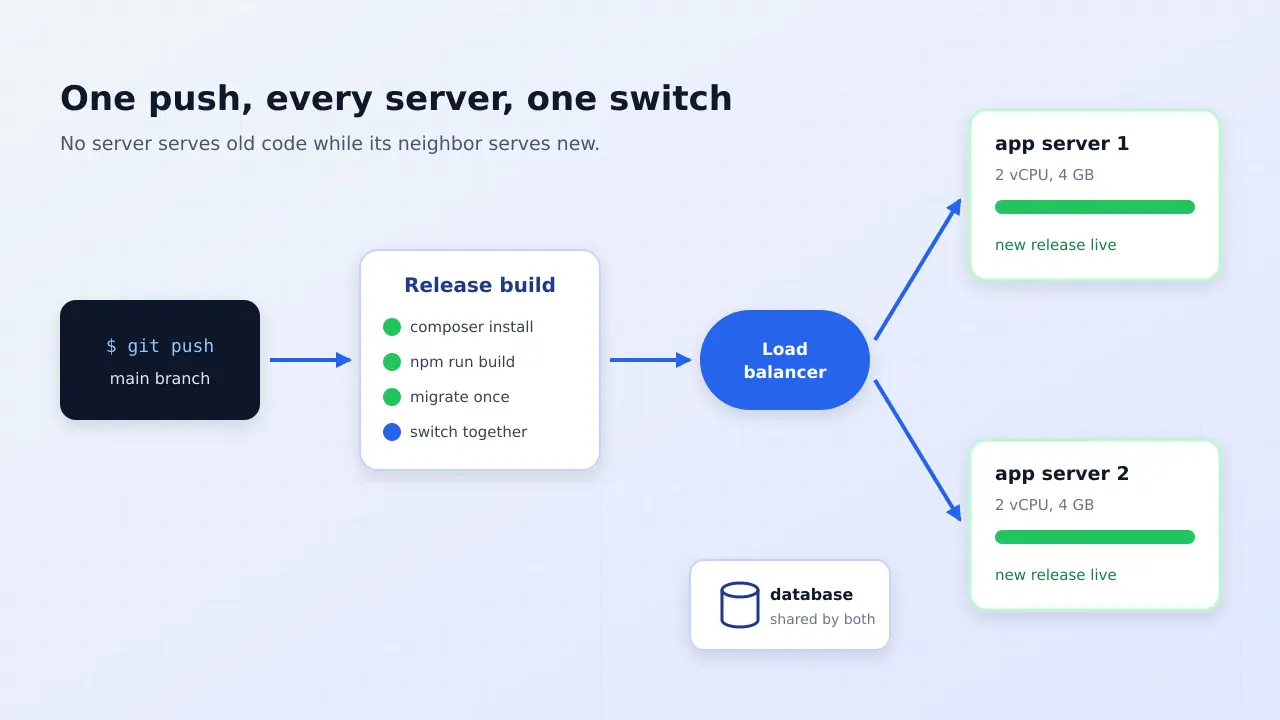
Diagram of a git push building one release, then switching two Laravel app servers behind a load balancer at the same time, with a shared database

The day one Linode stops being enough

Most Laravel apps on Linode start on a single 2 GB or 4 GB shared instance, and that is the right call. The pressure arrives later: a queue backlog during a campaign, a second app server behind a NodeBalancer, or a client who wants staging on its own box.

That is the point where deploys get risky. DeployManage treats every Linode behind a site as one target: it builds the release on each server first, runs migrations once, switches them together and restarts Horizon everywhere, so no server serves old code while its neighbor serves new.

What DeployManage does inside your Linode account

Laravel ready Linodes

Choose a Shared CPU, Dedicated CPU or High Memory plan in any US region. DeployManage creates the Linode through the Linode API, closes every port except 22, 80 and 443, and installs Nginx, PHP-FPM with the extensions Laravel needs, MySQL or Postgres, Redis, Composer and Supervisor.

Atomic releases on every push

Each deploy runs composer install, your asset build and php artisan migrate --force in a fresh release directory, then flips the current symlink in one step. Visitors never hit a half written vendor folder. Available on Growth and Business.

One release across several Linodes

Put two app servers behind a NodeBalancer ($10 a month) and every push lands on both together. Forge's native zero downtime deploys stop at one server per site, which is why Forge teams in this position add Envoyer at $10 to $50 a month.

Horizon, queue workers and the scheduler

Supervisor programs for php artisan horizon or queue:work are written for you and restarted after each release, so workers never keep running old code. The scheduler cron entry is created with the site.

Certificates and domains

Point a domain at the Linode and DeployManage issues a Let's Encrypt certificate, renews it before expiry and redirects HTTP to HTTPS. Behind a NodeBalancer you choose whether TLS ends on the balancer or on each server.

Seats, roles and an audit log

Growth includes 10 team members and Business is unlimited. Every deploy, rollback and SSH key change is logged with the person who made it, which matters when an agency runs Linodes for several clients.

How it works

  1. 1
    Create a Linode API token

    In Cloud Manager open your profile, then API Tokens, and create a personal access token with read and write access to Linodes (add NodeBalancers if you want the panel to see them). Paste it into DeployManage. You can revoke it in Cloud Manager at any time.

  2. 2
    Launch a Laravel server

    Pick a region near your users, for example Newark, Chicago or Dallas, and a plan such as a 2 vCPU, 4 GB shared Linode. It appears in your account like any other Linode and bills hourly up to the monthly cap.

  3. 3
    Connect the repository

    Choose GitHub, GitLab or Bitbucket and the branch. Paste the .env once; it is stored encrypted and written into each release. Add the Horizon or queue worker program if the app uses queues.

  4. 4
    Push to deploy

    On Growth and Business every push becomes an atomic release with a health check. If the new release fails, the previous one is still on disk and one click puts it back.

Ways to run Laravel on Linode compared

Software prices from each vendor's pricing page, read in September 2026. The Linode bill is identical in every column. The honest headline: Forge and Ploi are cheaper panels, a hand built server costs nothing extra, and DeployManage is the option that puts multi server atomic releases, team seats and an audit log on one plan.

swipe to see all columns →

What you are comparing DeployManage Laravel Forge Ploi Hand built server
Software fee Starter $59/mo, Growth $129/mo, Business $299/mo Hobby $12, Growth $19, Business $39 per month Basic $10, Pro $16, Unlimited $36 per month None
Linodes included 3 on Starter, 10 on Growth, unlimited on Business 1 external server on Hobby, unlimited on Growth and Business 5 on Basic, 10 on Pro, unlimited on Unlimited Any
Creates Linodes through the API Yes Yes, via an Akamai provider profile and API token Yes No, you click them in Cloud Manager
Zero downtime release Yes on Growth and Business, not on Starter Yes, on one server per site Yes on Pro ($16) and Unlimited ($36), not on Basic Only if you script it
Same release to several Linodes Yes on Growth and Business No, needs Envoyer at $10 to $50 more Yes, synchronized deploys of linked sites Only if you script it
Horizon and queue workers Supervisor, restarted each release Supervisor Supervisor You configure Supervisor
Also runs WordPress and Node.js sites Yes Yes Yes If you install them
Team seats 2 on Starter, 10 on Growth, unlimited on Business Per plan Per plan Shared root keys

Who it's for

A US team that already bills through Akamai

Companies that buy Akamai CDN or security often put compute on the same contract. Laravel on Linode then means one vendor relationship for the network and the servers, and a panel is the only extra line.

A Laravel app that outgrew one Linode

Two app servers behind a NodeBalancer and a separate database Linode is a normal next step. With Forge it also means Envoyer, two vendors and two dashboards. DeployManage Growth provisions all three and ships one release to both app servers.

An agency with client apps on Linode

Each client gets its own Linode in the region closest to its customers, the agency gets 10 seats on Growth, and the audit log answers who deployed what to which client, and when.

A fleet spread across clouds

Production on Linode, an older app on DigitalOcean, a client that insists on AWS. One panel, one deploy process and one set of SSH keys across all of them instead of three consoles.

Does Laravel Forge work with Linode?

Yes. Laravel Forge supports Linode as an Akamai server provider: you add a provider profile with a Linode API token and Forge creates and configures the Linode for you. Linode's own documentation still carries a guide to it. What decides the purchase are two limits on Forge's side. A Linode counts as an external server, so the $12 Hobby plan covers one of them, and Growth at $19 or Business at $39 is needed for more.

The second limit matters once a site grows. Forge's native zero downtime deployments work on one server per site. A Laravel app on two Linodes behind a NodeBalancer cannot use them, so Forge teams at that stage buy Envoyer as well, at $10, $20 or $50 a month. That pairing works and many teams run it. It is also two subscriptions, two dashboards and two places to look when a deploy fails, which is the gap DeployManage fills by provisioning the Linodes and running the fleet wide release in one plan. If you need a single Linode for a single app, Forge Hobby is cheaper than anything on this page, and we would tell you to buy it. Our full Laravel Forge alternative page covers the rest of the trade offs.

How much does it cost to host Laravel on Linode?

A production Laravel app on Linode costs about $15 to $45 a month for the infrastructure at small scale: a $12 or $24 shared Linode, $2.50 or $5 for backups, and optionally a $16 managed MySQL node. The panel fee comes on top. These are the prices Linode's public API returned in September 2026 for US regions.

SetupLinode billForgePloiDeployManage
One small app, 2 GB Linode plus backups$14.50$26.50 (Hobby)$24.50 (Basic)$73.50 (Starter)
4 GB Linode, backups, 1 GB managed MySQL$45$57 (Hobby)$55 (Basic)$104 (Starter)
Two 4 GB app Linodes, NodeBalancer, 4 GB database Linode, backups on all three$97$126 (Growth plus Envoyer Basic)$107 (Basic)$226 (Growth)
Agency, eight 2 GB client Linodes with backups$116$135 (Growth)$132 (Pro)$245 (Growth)

DeployManage is the most expensive line in every row, and the table says so on purpose. The third row is where the difference in what you get shows up: the Forge total needs a second vendor to release to both app servers at once, and the DeployManage total includes that plus 10 seats and the audit log. Paying yearly halves the DeployManage figure ($29, $64 or $149 a month). Linode's own charges do not change with the panel, and outbound transfer beyond your pooled allowance costs $0.005 per GB, so a 1 TB overage is $5. For a wider view across clouds, see how much a Laravel VPS costs.

Still choosing between providers? Our Linode vs DigitalOcean pricing comparison prices five real setups on both, from a single 2 GB app to a traffic heavy media site.

Which Linode plan is best for Laravel?

For most Laravel apps the best Linode plan is the 2 vCPU, 4 GB shared plan at $24 a month, which includes 80 GB of storage and 4 TB of transfer. It runs PHP-FPM, Redis, a Horizon supervisor and a small MySQL comfortably. Start with the 1 vCPU, 2 GB plan at $12 only for a low traffic app with light queues.

PlanvCPU / RAMStorage / transferPriceBackupsGood for
Nanode1 / 1 GB25 GB / 1 TB$5$2Staging, a demo
Shared 2 GB1 / 2 GB50 GB / 2 TB$12$2.50One small production app
Shared 4 GB2 / 4 GB80 GB / 4 TB$24$5Most production apps
Shared 8 GB4 / 8 GB160 GB / 5 TB$48$10Several apps, heavier queues
Dedicated 4 GB2 / 4 GB80 GB / 4 TB$36$5Queue workers at 100 percent CPU
Dedicated 8 GB4 / 8 GB160 GB / 5 TB$72$10Busy API or report generation

Shared CPU is fine for web requests, which are short and bursty. Move to Dedicated CPU when Horizon workers sit near full CPU for long stretches, for example during PDF generation or imports, because shared cores can be throttled when neighbors are busy. Linode's managed MySQL starts at $16 a month for a 1 GB single node and $37 for a three node cluster, which is worth it when nobody on the team wants to own database upgrades.

Is Linode good for Laravel hosting?

Yes. Linode is a solid Laravel host for US teams: ten US regions (Newark, two in Washington DC, Atlanta, Miami, Chicago, Dallas, Fremont, Los Angeles and Seattle), flat monthly caps on hourly billing, generous included transfer and one of the lowest overage rates among the mainstream clouds. At the common sizes its prices match DigitalOcean and Vultr to the dollar, $12 for 2 GB and $24 for 4 GB.

Where it differs is the Akamai connection. Teams that already use Akamai's CDN or security products can keep compute on the same account. The weaker spots are the ones every plain cloud has: no managed Laravel runtime, so provisioning, PHP upgrades, Supervisor, certificates and deploys are yours to run, either by hand or through a panel. That is the job this page is about. If you are still choosing between clouds, our Laravel on DigitalOcean and Vultr Laravel hosting pages run the same numbers for those two.

How do I deploy Laravel to Linode with zero downtime?

Deploy each release into a new directory, build it completely, then switch a symlink, so the web server moves from the old code to the new code in one step. On a Linode that means a releases folder, a shared folder for storage and .env, and a current symlink that Nginx points at. Migrations run once, and queue workers restart after the switch.

Doing it by hand is possible with Deployer or a shell script and works well on one server. It gets harder on two Linodes behind a NodeBalancer, because both servers must have the new release built before either switches, and a failure on one must roll back both. DeployManage runs that sequence for you on Growth and Business: build everywhere, migrate once, switch together, restart Horizon on each server, and keep the previous release on disk for a one click rollback. Starter provisions and manages the Linodes but deploys in place. For the mechanics in more depth, read our guide to deploying Laravel to a VPS.

Can I move a Laravel app to Linode from DigitalOcean, Vultr or AWS?

Yes, and the move is mostly a database copy and a DNS change. Create the new Linode through the panel, deploy the same repository and branch, copy storage files with rsync, restore a fresh database dump, then lower the DNS TTL a day ahead and switch the record. Keep the old server running for a few days as a fallback.

Because DeployManage manages servers on DigitalOcean, Vultr, Hetzner, AWS and Linode from one account, both the old and new servers sit in the same dashboard during the move, and the deploy settings, environment file and worker programs carry over. Teams leaving AWS usually do it for predictability: a $24 Linode with 4 TB of transfer included replaces an EC2 instance, a public IPv4 charge and per gigabyte egress. Our Laravel on AWS page has the matching AWS bills if you want to compare line by line.

Ready to stop managing servers by hand? DeployManage provisions, deploys and monitors your fleet from one dashboard.

Get started
Frequently asked questions

Does Laravel Forge work with Linode?

Yes. Forge supports Linode through an Akamai provider profile and a Linode API token. A Linode counts as an external server, so Forge Hobby at $12 covers one, and Forge's native zero downtime deploys work on one server per site. Several Linodes behind a NodeBalancer need Envoyer as well, or a panel that releases to all servers at once.

Is Linode good for Laravel hosting?

Yes. Linode offers ten US regions, flat monthly caps and prices that match DigitalOcean and Vultr at common sizes: $12 for 2 GB and $24 for 4 GB. It has no managed Laravel runtime, so you need a panel or your own scripts for provisioning, PHP upgrades, workers and deploys.

How much does it cost to host Laravel on Linode?

About $15 to $45 a month for infrastructure at small scale: a $12 or $24 shared Linode, $2.50 or $5 for backups and optionally $16 for managed MySQL. A panel adds $10 to $19 for Ploi or Forge, or $59 to $129 for DeployManage, which is the most expensive option and includes multi server releases and team seats.

Is Linode the same as Akamai Cloud?

Yes. Akamai bought Linode in 2022 and now sells the platform as Akamai Cloud. Cloud Manager, the Linode API and the plan names such as Nanode and Dedicated CPU still use the Linode name, and tools like Forge list the provider as Akamai.

Which Linode region should a US company use for Laravel?

Pick the region closest to most of your users. Newark or Washington DC for East Coast customers, Chicago or Dallas for the middle of the country, Fremont, Los Angeles or Seattle for the West Coast. Prices are the same in every US region, so choose on latency and where your database lives.

Can Laravel Horizon run on a Linode?

Yes. Horizon needs Redis and a Supervisor program that keeps php artisan horizon running. DeployManage writes that program, installs Redis on the server and restarts Horizon after every release so workers never run old code. For sustained heavy queues a Dedicated CPU Linode avoids throttling on shared cores.

Is there a Laravel Forge alternative that deploys to several Linodes at once?

Yes. DeployManage Growth ($129 a month, or $64 a month billed yearly) provisions up to 10 Linodes and ships one atomic release to every server behind a site, with rollback and 10 team seats. Forge plus Envoyer does the same job for less money across two subscriptions.

Related

Laravel Forge alternative Laravel Envoyer alternative Laravel on DigitalOcean Vultr Laravel hosting Deploy Laravel to Hetzner Deploy Laravel to AWS EC2 Ploi alternative How much a Laravel VPS costs Linode vs DigitalOcean pricing Deploy Laravel to Google Cloud

Put Laravel on Linode without building the server by hand.

Paste a Linode API token, launch a server in any US region and push your first atomic release. Every account starts with a one-time demo, no card required.

Get started Pricing

One-time demo, no credit card required.