Cleavr Alternative and Cleavr Pricing Compared at 1 to 25 Servers
Cleavr costs $5.50 a month for one server (Lite), $15 for unlimited servers (Pro) or $30 with team members and API access (Business). That makes it one of the cheapest server panels, so the best Cleavr alternative depends on why you are leaving. For a bigger PHP vendor at a similar price, Laravel Forge ($19 for unlimited servers) or Ploi ($16 for 10). For WordPress, RunCloud or ServerAvatar. For a team that needs seats, atomic releases and one deploy log across clouds, DeployManage at $59 to $299 a month.
Skip the manual setup. DeployManage provisions your server and ships zero-downtime deploys on any cloud.
Get startedCleavr is one of the cheapest server panels you can buy. Pro is $15 a month for unlimited servers, it deploys PHP and Node apps alike, and it has a rollback button. So most people searching for a Cleavr alternative are not running from the price. They have hit one of three walls: they need teammates in the panel and only the $30 Business plan has team members, they want a vendor that publishes exactly how its deploys switch releases, or they want a panel built around a specific stack such as Laravel or WordPress.
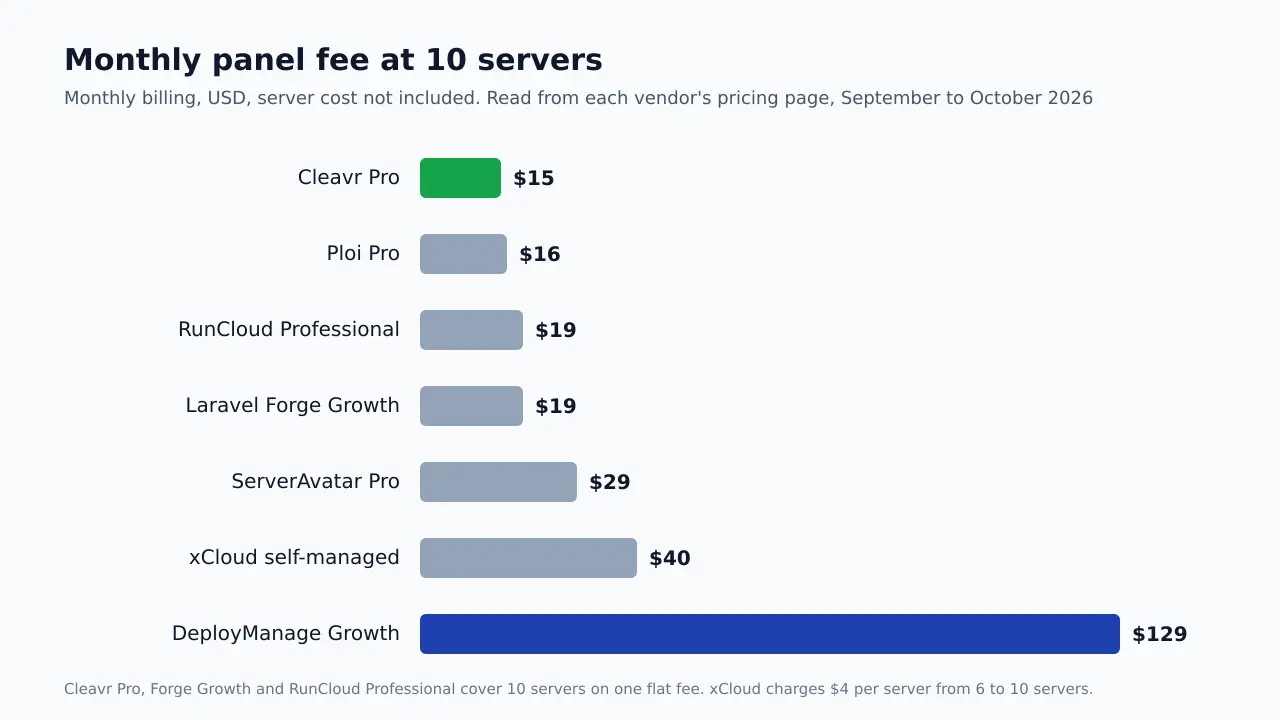
This page puts Cleavr next to six alternatives on the numbers that decide a switch: the monthly fee at 1, 5, 10 and 25 servers, team seats, and how each one deploys. Every price is the vendor's own published monthly price in USD, read between September and October 2026, and server cost is never included because all of these panels drive servers in your own cloud account.
Cleavr pricing and plans
Cleavr has three plans: Lite at $5.50 a month for one server, Pro at $15 a month for unlimited servers, and Business at $30 a month, which adds team members, team resource management and the Cleavr API. Paying yearly costs $66, $180 or $360. Every plan includes unlimited sites, apps and deployments, and there is a 5-day trial of Pro with no card required.
| Cleavr plan | Monthly | Yearly | Servers | What it adds |
|---|---|---|---|---|
| Lite | $5.50 | $66 | 1 | Unlimited apps, cron jobs, process monitors |
| Pro | $15 | $180 | Unlimited | Server monitoring, log reports, database and filesystem backups, quick scripts |
| Business | $30 | $360 | Unlimited | Team members, team resource management, API access |
Cleavr deploys Laravel, plain PHP, WordPress, Node.js, Nuxt, Next, AdonisJS, Strapi, Directus and static sites, on DigitalOcean, Hetzner, AWS, Linode, UpCloud, Vultr or a custom server. Its docs describe rollback to one of the last couple of deployments, which points the site back to the previous directory. They do not say how many releases are kept.
What is the best Cleavr alternative?
For a solo developer on PHP, Ploi or Laravel Forge is the closest Cleavr alternative at a similar price: Ploi Pro is $16 for 10 servers and Forge Growth is $19 for unlimited servers, both with zero downtime deploys. For a WordPress shop, RunCloud or ServerAvatar. For a team or agency that needs seats, atomic releases and a deploy log across several clouds, DeployManage, at a much higher fee.
If you run Node apps such as Nuxt or Next next to PHP, be careful. Cleavr's app list is broader than most PHP panels, and moving may mean running those apps somewhere else.
Cleavr alternatives compared by price at fleet size
| Panel | 1 server | 5 servers | 10 servers | 25 servers |
|---|---|---|---|---|
| Cleavr | $5.50 (Lite) | $15 (Pro) | $15 | $15 |
| Ploi | $10 (Basic) | $10 | $16 (Pro) | $36 (Unlimited) |
| Laravel Forge | $12 (Hobby) | $19 (Growth) | $19 | $19 |
| RunCloud | $9 (Essentials) | $19 (Professional) | $19 | $19 |
| ServerAvatar | $12 (Newbie) | $12 | $29 (Pro) | $29 |
| xCloud self-managed | $0 for 1 server and 10 sites | $25 | $40 | $75 |
| DeployManage | $59 (Starter) | $129 (Growth) | $129 | $299 (Business) |
Two things stand out. Cleavr is the cheapest panel in the table from five servers up, and it stays at $15 no matter how many servers you add. And the gap to the next cheapest is small: Ploi, Forge and RunCloud all sit between $16 and $19 at ten servers. If price is the only thing that matters, stay on Cleavr. Our own plans cost several times more, half that when billed yearly ($29, $64 or $149 a month), and the rest of this page is about whether the extra buys anything you need.
Does Cleavr support team members?
Only on the Business plan at $30 a month. Lite and Pro are single user, so a freelancer who brings in a second developer, or an agency that gives contractors access, has to move up to Business. That doubles the Pro bill but is still cheap next to most alternatives.
Compare the seat rules elsewhere. Forge lets you share servers with teammates on every plan, including the $12 Hobby. Ploi's server sharing is on the Unlimited plan. RunCloud's Business tier at $49 includes 10 seats. DeployManage includes 2 members on Starter, 10 on Growth and unlimited on Business, and every deploy, rollback and SSH key change is logged with the person who made it. If your reason for leaving is seats, check whether Cleavr Business already solves it before you migrate anything.
Does Cleavr do zero downtime deployments?
Cleavr's deployment docs describe a sequence of actions, a rollback to one of the last couple of deployments that points back to the previous directory, and hooks you can run after a rollback. They do not describe the release layout, symlink switch or number of releases kept, so test a deploy under load before you rely on it.
Laravel Forge includes zero downtime deploys on every plan, on one server per site; deploying one project to several servers still needs Envoyer. Ploi has them on Pro and Unlimited. RunCloud gates atomic deploys to its $49 Business tier. In DeployManage, Growth and Business build each release in a fresh directory with a shared .env and storage, switch the current symlink in one step and keep the last five releases, so a failed composer install or migration never reaches the live site. For the mechanics, see our zero downtime deployment page.
Which alternative fits which Cleavr customer
| If you are | Look at | Why |
|---|---|---|
| A solo PHP or Laravel developer who wants a bigger vendor | Laravel Forge or Ploi | Similar price, zero downtime deploys, large user base |
| A WordPress freelancer or agency | RunCloud, ServerAvatar or xCloud | WordPress tooling, staging and backups built in |
| Running Node apps such as Nuxt or Next next to PHP | Stay on Cleavr, or Forge | Forge lists Node.js, Nuxt and Next.js support; most PHP panels do not |
| An agency with contractors and client audits | DeployManage or Cleavr Business | Seats, per person deploy history, exportable logs |
| A team spread across several clouds | DeployManage | One panel for DigitalOcean, Hetzner, AWS, Vultr, Linode and plain SSH servers, with atomic releases on Growth |
The individual pages go deeper: Ploi pricing compared, the Laravel Forge alternative page, RunCloud pricing and alternatives and the xCloud per-server fee worked out. If the app you are moving is a Filament admin panel, our page on Filament hosting covers the queue workers and deploy script it needs.
How to move off Cleavr without downtime
The servers belong to you, so leaving Cleavr is not a migration of data between hosts. It is a handover of control from one panel to another, and you can do it one site at a time.
Start by writing down what Cleavr manages for each site: the deployment hooks, environment variables, cron jobs, process monitors and queue workers. Then build a fresh server with the new panel rather than adopting the old one, since a panel that did not provision a server cannot be sure what is on it. Deploy the app there, copy the database, and test against the server IP with a hosts file entry. Lower the DNS TTL a day before, switch the record, and keep the old server for a week before deleting it. If several developers and contractors deploy, write the new deploy routine down and put it in front of them as a short internal training course, so nobody keeps pushing the old way out of habit.
Only cancel Cleavr after the last site is live elsewhere. Your servers keep running either way, but the old panel's cron and monitor entries are the easiest thing to forget.
Who should stay on Cleavr
If you are one developer on Pro with a handful of servers, deploy a mix of PHP and Node apps, and have no complaints about deploys, there is no price reason to move. Every alternative here costs the same or more. The case for switching is narrower and specific: seats on a cheaper plan elsewhere, a vendor tied to your framework, documented atomic releases, or a single audit trail for client work. If those are your reasons, start a one-time demo on DeployManage pricing with 1 server, 1 site and 1 deployment, no card, and run a real deploy before you commit.
Ready to stop managing servers by hand? DeployManage provisions, deploys and monitors your fleet from one dashboard.
Get startedFrequently asked questions
How much does Cleavr cost?
Cleavr Lite is $5.50 a month for one server, Pro is $15 a month for unlimited servers, and Business is $30 a month with team members and API access. Yearly billing is $66, $180 or $360. All plans include unlimited sites and deployments, and Pro has a 5-day trial with no card.
What is the best Cleavr alternative?
For a solo PHP developer, Laravel Forge ($12 to $39) or Ploi ($10 to $36). For WordPress work, RunCloud or ServerAvatar. For a team or agency that needs seats, atomic releases and a deploy log across clouds, DeployManage from $59 a month.
Is Cleavr cheaper than Laravel Forge?
Yes. Cleavr Pro covers unlimited servers for $15 a month, while Forge Growth is $19. With one server, Cleavr Lite at $5.50 also beats Forge Hobby at $12. Forge includes teammate sharing on every plan, which Cleavr only offers on Business at $30.
Does Cleavr support team members?
Only on the Business plan at $30 a month, which adds team members, team resource management and API access. Lite and Pro are single user.
Does Cleavr support rollbacks?
Yes. Its docs describe rolling back to one of the last couple of deployments from the deployment list, which points the site back to the previous directory, and you can run scripts after a rollback.
Can Cleavr deploy Node.js apps?
Yes. Cleavr lists Node.js, Nuxt, Next, AdonisJS, Strapi and Directus next to Laravel, PHP, WordPress and static sites. That breadth is a reason to stay if you run Node apps, because many PHP panels do not cover them.
Which cloud providers does Cleavr work with?
DigitalOcean, Hetzner, AWS, Linode, UpCloud and Vultr, plus a custom server option for any machine you can reach over SSH.
Is DeployManage cheaper than Cleavr?
No. DeployManage costs $59, $129 or $299 a month, or half that billed yearly, against Cleavr's $5.50 to $30. It fits teams that need seats on lower tiers, atomic releases with five kept releases, and one deploy log across several clouds.